Your Refund Policy Lives in a Dozen Different Agents. They Already Disagree.
A telecom customer can ask for money in a dozen places: chat, voice, the IVR, the app, retail, and the two to five outsourced call centers you run, across multiple markets, currencies, and regulators. Each one decides what a customer is owed from its own system prompt. Each one drifts. None of them share an audit trail.
Every other tool is built for a single agent. A telecom operator has a dozen surfaces where a customer asks for money. That is the problem no single-agent tool can solve, and the reason a refund, credit, waiver, or SLA payment needs one authority instead of a dozen copies.
One agent is not the unit of the problem. The channel is.
Most AI governance is scoped to a single agent: one bot, one prompt, one set of guardrails. That framing fits a company with one place a customer can reach. A telecom operator is not that company. A customer who wants a bill credit can get it from any of these, and each is a separate decision-maker:
- → The chat agent on the website and in the app
- → The voice agent and the IVR
- → The retail point of sale
- → The two to five outsourced BPOs, each with its own desktop and its own prompt
- → The same set again in every market, in every currency, under every regulator
Policy that lives inside one vendor's agent is re-implemented in each of the others, and re-implemented policy drifts. Not because anyone changed it on purpose, but because a rule copied into a dozen prompts is a dozen rules the day after. This is policy drift, and at agent speed it is not a slow leak. It is the default state.
This is also where the automation stalls. The next third of contact containment is exactly these money decisions, the ones every channel currently hands to a human. See what the ceiling costs.
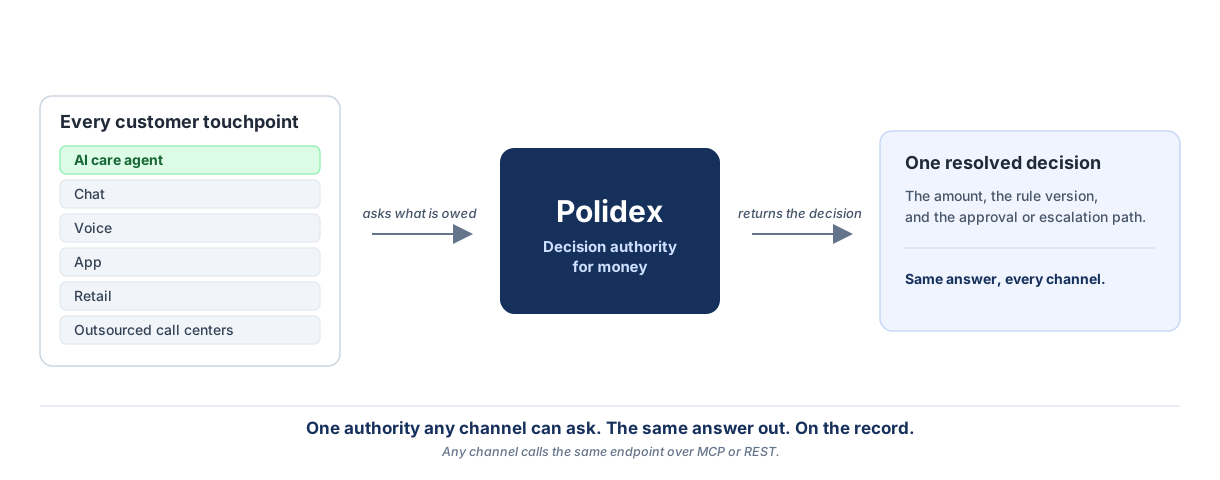
The failure is not one bad refund. It is the same wrong rule, everywhere, for weeks.
Picture the SLA-credit rule for a regional outage set one day of credit too high. On a human team, a supervisor catches it after a handful of cases. With humans removed from the decision, it fires across chat, voice, the app, and three outsourced call centers, in four markets, for six weeks, before finance reconciles the numbers and notices.
Then the regulator asks the question that has no answer: which rule applied to which customer, on which channel, and were they treated consistently? That answer does not exist in N system prompts. It never existed. Nobody wrote it down in a form anyone can query.
One wrong decision is an incident.
The same wrong decision on every channel, unprovable, is a governance failure.
This is not the job your billing system does.
Your billing and BSS stack records what happened: what the customer was charged, what they paid, what the plan costs. It is authoritative for that. What it does not do is decide what the customer is entitled to when something goes wrong, or who is allowed to authorize it. That decision has never had a system of its own.
That is the gap Polidex fills. When a customer is owed a credit, a waiver, a refund, or an exception, Polidex resolves it: the amount, the rule that applied, and the approval path, the same way on every channel, before anything reaches billing.
A cap is not a decision.
A guardrail can do exactly one thing: "credit up to $50, otherwise escalate." That is a limit, not an answer. It tells the agent what it cannot do and leaves the actual decision unmade. Take a customer disputing a $180 roaming charge. Here is what the decision your policy actually makes looks like:
If you never sent a bill-shock warning, credit the full overage. If you did warn them but they have been with you five years, credit half as goodwill. Cap it either way at one month's plan value. And if this is their second goodwill credit in 90 days, don't auto-approve it, route it to a supervisor. Then apply the credit, flag whether to offer a roaming pack so it doesn't recur, and log which rule version decided it.
That is the amount, the rule, the approval path, and the audit record, resolved in one call, the same way on every channel. A cap any one agent can enforce. A decision is what a telecom operator actually needs, on every channel, on the record.
Why this is happening now
Operators ran for thirty years without a machine-readable decision authority because the authority was a person. A care agent with judgment, and a supervisor as the backstop. The billing system recorded what happened. The human decided what was owed.
AI agents are removing that human from money decisions this year, at scale, on every channel at once. That deletes the judgment, multiplies the blast radius of a wrong rule, hard-codes the fragmentation into every new channel and BPO as it stands up, and trips a new regulatory clock: autonomous customer-facing money decisions are now an auditable category under EU AI Act Article 26 deployer duties and Ofcom consumer-credit rules. Nothing is replacing the judgment. The one thing that can replace it consistently is an authority every channel calls, not a prompt every channel copies.
Related
- The decision authority for money: the one rulebook every channel obeys, and how it works for a telecom operator.
- The automation ceiling: why AI agents stall at 30% containment, and what the money decisions cost.
- The policy gap: the structural reason policy in system prompts cannot scale.
- How Polidex works: how a channel query becomes a resolved decision, a signed token, and an audit record.
Working through how to deploy agentic CS?
If you're at a telecom operator or enterprise evaluating agentic AI for your operation, we'd welcome a conversation about what containment is realistic, what the policy layer needs to look like, and how to make the deployment defensible.
Start a Conversation