One authority for every money decision your customers reach.
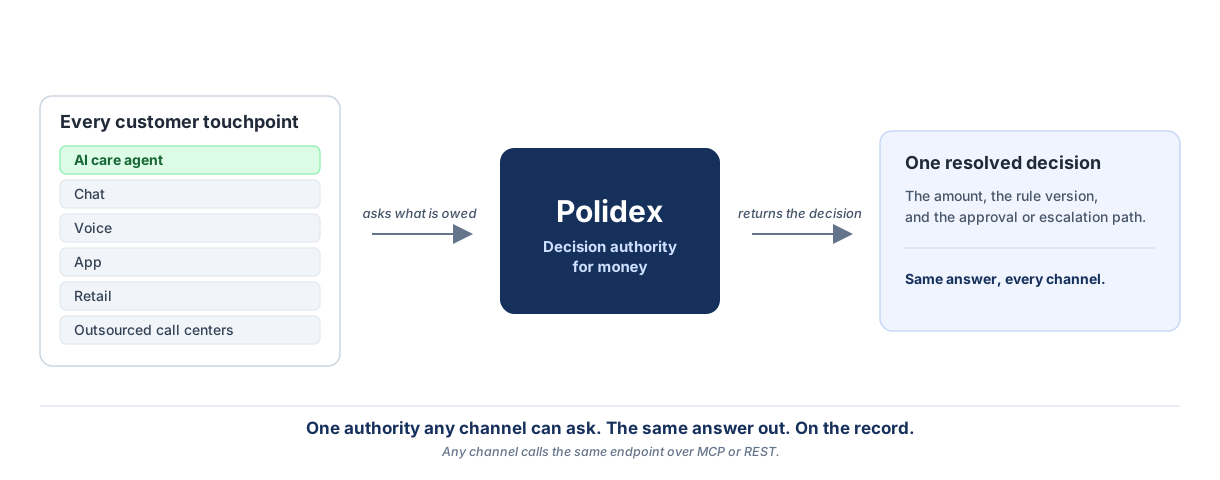
Polidex is the decision authority for refunds, credits, ETF waivers, and SLA compensation across telecom customer operations. Every AI agent, IVR, app, and outsourced call center obeys the same rules, so the answer is the same, correct, and provable everywhere. Not a guardrail. Not locked inside one vendor's bot.
Money is where it bites first, but the problem is bigger. Every entitlement, exception, and escalation your agents decide needs one answer, not a dozen. Polidex is the rulebook your whole operation obeys, consistent across every channel and provable after the fact.
Every other tool is built for a single agent. You have a dozen places a customer can ask for money.
Chat, voice, IVR, the app, retail, and two to five outsourced call centers, across multiple markets, currencies, and regulators. When policy lives inside one vendor's agent, it is re-written and drifts in every one of them, is locked to a vendor you may be mid-migration from, and produces no cross-channel audit trail.
For thirty years your decision authority for money was a person with a headset: a care agent with judgment, a supervisor as backstop. You are replacing that person this year, with software that has a system prompt instead of judgment, no supervisor, and no memory of what it was allowed to do. The risk is not one bad refund. It is the same wrong SLA-credit rule firing across chat, voice, the app, and three outsourced call centers, for six weeks before finance reconciles it, and then not being able to tell the regulator which rule applied to which customer.
This is the difference between a cap and a decision. Take a customer disputing a $180 roaming charge, one of the most common money contacts in your markets. A guardrail can do exactly one thing: “credit up to $50, otherwise escalate.” That is a limit, not an answer: it tells the agent what it cannot do and leaves the actual decision unmade. Here is what the decision your policy actually makes looks like:
If you never sent a bill-shock warning, credit the full overage. If you did warn them but they have been with you five years, credit half as goodwill. Cap it either way at one month's plan value. And if this is their second goodwill credit in 90 days, don't auto-approve it, route it to a supervisor. Then apply the credit, flag whether to offer a roaming pack so it doesn't recur, and log which rule version decided it.
That is the amount, the rule, the approval path, and the audit record, resolved in one call, the same way on every channel.
A cap is not a decision. A decision is what a telecom operator needs, on every channel, on the record.
See how it works for telecom operators →The money decisions are where it breaks, and where it stalls
The contacts AI cannot resolve without a decision authority cluster into money decisions. Each shares the same structure: the agent can hear the question and access the account, but it cannot answer, correctly and consistently with every other channel, what the customer is owed. These are also exactly the contacts where containment stalls.
Billing disputes and credit requests
20-25% of contacts
The agent can verify what happened but cannot determine what the customer is entitled to.
Plan changes and upgrade eligibility
10-12% of contacts
The agent knows what plans exist but cannot determine whether this customer qualifies.
Retention offers
8-10% of contacts
The agent detects the churn signal but cannot determine what offer this customer qualifies for.
SLA and outage compensation
3-5% of contacts
The agent can confirm the outage but cannot determine what the customer is owed.
These are not AI capability problems. They are policy infrastructure problems. The agent does not know the answer because the answer does not exist anywhere the agent can reliably access.
See the full model and ROI →Why system prompts cannot fix it
Operational failure
The system prompt grows to thousands of words through incident edits, each team member updating the rule that burned them most recently. There is no version history. No approval workflow. No conflict detection. When someone edits it, the old policy is gone. When the same rule is described differently across pages, no one knows which version the agent is applying today.
This is policy drift: not the result of a deliberate change, but the inevitable consequence of managing policy as a document.
Architectural failure
Transformer models weight recent context more heavily than static instructions. By turn 20 of a complex billing dispute, the policy guidance at the top of the context has less influence than the last three customer messages. This is not a flaw in any specific model. It is how the architecture works. When conversation history grows, the policy signal weakens. The longer the contact, the more likely the agent makes a wrong call.
A system prompt is not a policy layer. It is an editable document: no version history, no approval, no record of who changed the rule or when.
Why system prompts fail as policy →Your agent doesn't decide. Your policy does.
Instead of interpreting policy from a system prompt, your agent calls Polidex. Polidex queries your systems for the full picture, evaluates the request against versioned eligibility rules, and issues a decision token: a signed, versioned record the agent and downstream systems require before acting.
No valid token, no action.
1. Agent submits the request
Who the customer is and what they're asking: The minimum the agent knows. Polidex queries your systems for the rest, so the agent can't invent context.
2. Polidex queries context and evaluates policy
Retrieves the full customer record from your connected systems, then applies versioned eligibility rules to determine what's authorized.
3. Decision token issued
A signed, versioned record, authorized, denied, or escalate, with the policy version and authorization path. Downstream systems require the token; the agent can't act without it.
The cost of operating without a policy layer
This is not hypothetical. The model is built from publicly documented industry benchmarks for enterprise customer support operations at telecom operator scale.
| Stage 1: No Policy Layer | Stage 2: With Polidex | |
|---|---|---|
| Contact containment | 30% | 60%+ |
| Effective cost per contact | $12.36 | $7.14 |
| Annual cost (10M-subscriber telecom operator) | $272M | $157M |
| Annual savings vs. baseline | $168M | $283M |
The $115M incremental savings from Stage 1 to Stage 2 are not recoverable by any other means. Better models do not solve a policy infrastructure gap. More training data does not version a refund policy. And every quarter a competitor operates at Stage 2 while you are at Stage 1, the cost-per-contact advantage compounds in their favor.
See the full methodology →What changes when you add a policy layer
| Without Polidex | With Polidex |
|---|---|
| Every channel decides from its own copy of the policy | One source of truth every channel calls, the same decision everywhere |
| Policy lives in a system prompt | Policy is versioned, queryable infrastructure |
| No audit trail | Every decision has a record with a policy citation |
| Policy updated by whoever has edit access | Policy governed and versioned by business owners |
| Inconsistency compounds at agent speed | Consistent by construction |
| No authorization gate: The agent decides without a check | No valid authorization token, no action |
| 30% contact containment | 60%+ contact containment |
| $12.36 effective cost per contact | $7.14 effective cost per contact |
“78% of executives cannot pass an AI governance audit within 90 days.”
Grant Thornton, April 2026
“The bigger risk becomes delegating authority to AI systems.”
Alessandro Perilli, VP AI Research, IDCWhat delegating authority to AI actually requires →
“AI accountability, security, auditability, traceability, and guardrails, is the #1 purchase factor for AI infrastructure, ahead of cost and vendor reputation.”
Jitterbit survey of 1,500 IT leaders, March 2026
December 2027 is closer than it looks.
EU AI Act enforcement arrives in two waves. Article 50 transparency obligations are already in force: any AI system interacting with customers must disclose that it is an AI. The consequential deadline for your AI agents is December 2027, when Annex III high-risk system requirements take effect with full enforcement authority. Your AI agents are the regulated systems, and the compliance obligations fall on you as their deployer. The requirements, audit trails, explainability, and purpose limitation enforcement, are not satisfied by governance documents or system prompts. They require infrastructure that enforces authorization before the agent acts and produces a tamper-evident record of every decision.
For telecom operators, the obligation is already live. FCC customer protection standards and Ofcom requirements create accountability obligations when AI agents make autonomous decisions affecting billing, contracts, and service commitments. When a regulator asks what rule your agent applied to a specific SLA credit or ETF waiver, and when, “it's in the system prompt” is not a defensible answer.
Enterprise procurement and implementation typically takes 12 to 18 months. The organizations that will be able to demonstrate compliance by December 2027 are the ones building infrastructure now. The question regulators ask is not “does your AI have policies?” It is “what was the agent authorized to do, under which version of policy, at which time?” A Polidex authorization record answers that question. A system prompt does not.
What EU AI Act actually requires of AI agents →Go deeper
The policy layer argument has many dimensions. Here is where to go deeper.
Why 40% of contacts require a policy decision the agent cannot make, and what the full cost model looks like.
The complete index of specific failure modes: from system prompt drift to governance accountability gaps.
The two agentic CS architecture paths and the $173M cost of choosing the wrong one.
Concepts, mechanisms, comparisons: the complete reference for how the policy layer functions.
Over 50 pre-configured rules for telecom CS operations, five authority tiers, 12 escalation conditions.
Prove what your autonomous systems were authorized to decide, for a specific customer, on a specific channel, under EU AI Act Article 26 and Ofcom / TCP.
What it actually means to delegate decision-making authority to an AI system.
Working through how to deploy agentic CS?
If you're at a telecom operator or enterprise evaluating agentic AI for your operation, we'd welcome a conversation about what containment is realistic, what the policy layer needs to look like, and how to make the deployment defensible.
Start a Conversation